
The Art of BankCraft™
BankCraft Classroom
Verify Before You Apply!
A new digital bank can look polished, promising, and perfectly ordinary. Before handing it your identity or connecting an existing account, make sure you know who is actually on the other side of the screen.
By D.B. Nomad · Published and last reviewed October 22, 2026
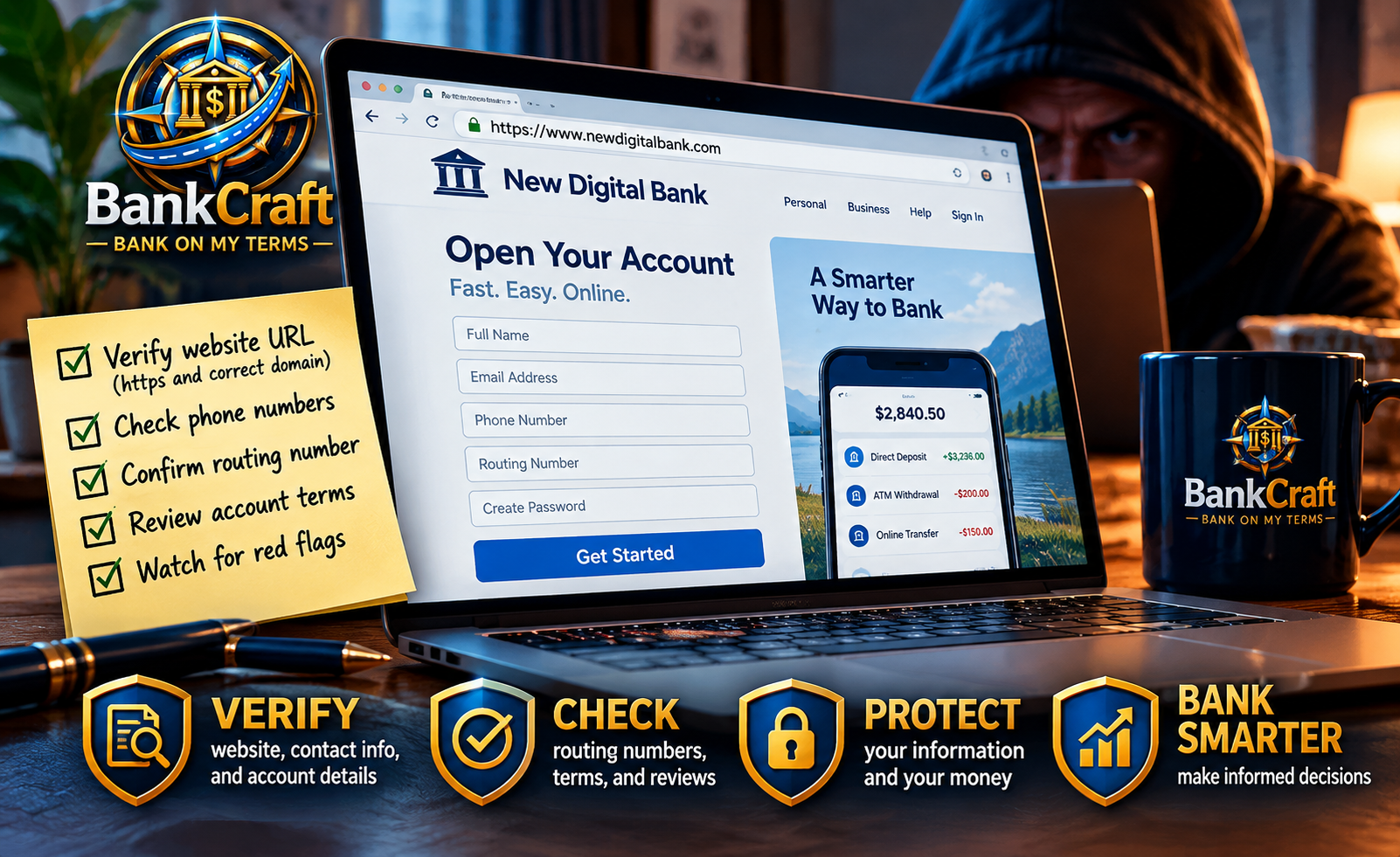
The first risk may arrive before the first deposit.
I've spent plenty of time auditioning financial institutions. A shiny website, an attractive APY, and a smooth application can make a new digital bank look ready for a job in my Financial Symphony. But a good-looking website is not proof that the institution behind it is who it says it is.
Think about what an application may request: your name, address, date of birth, Social Security number, identification, telephone number, and sometimes the routing and account numbers for a bank you already use. That's a great deal to hand over before you've moved a single dollar.
This lesson is not an accusation against any particular website or digital bank. It's a repeatable process for checking an unfamiliar institution before applying.
First, find out who the bank actually is.
Some digital brands are banks with their own charters. Others are divisions, marketing names, or financial technology companies offering services through a separate bank. Those arrangements can be legitimate, but the name on the website may not be the name in the federal regulator's database.
1. Identify the legal institution.
Look for the actual bank or credit union name in the website's disclosures, deposit agreement, and insurance language. If it says “banking services provided by” another institution, write that name down. If you can't identify the legal institution, stop and ask.
2. Check the official regulator's records.
For banks, use the FDIC BankFind Suite. For federally insured credit unions, use NCUA Research a Credit Union. Search for the actual legal institution, not just the marketing name.
A listing helps establish that the institution exists and its insurance status. It does not establish that an unfamiliar website is operated by, or legitimately partnered with, that institution.
3. Confirm the relationship independently.
Find the institution's telephone number through its regulator listing or its independently located official website. Call and ask whether the digital brand and website are genuinely associated with it. Don't rely solely on the number printed on the unfamiliar website you're investigating.
A real bank behind a brand is a starting point. You still need to confirm that the brand and the website belong together.
Verify the website and contact information.
A lock icon and https mean the connection is encrypted. They do not prove that the business is legitimate. A questionable site can have a valid security certificate, a professional design, customer-service hours, and convincing testimonials.
- Inspect the full domain name, not just the logo or page title. Watch for extra words, altered spellings, and lookalike domains.
- Find the website independently instead of trusting a link from a message, advertisement, or social-media conversation.
- Check when the domain was registered using ICANN Lookup. A brand-new domain is a reason for extra questions, not proof of fraud; legitimate new businesses also register new domains.
- Compare contact information and the claimed legal institution with independent records.
- Ask whether the bank or credit union recognizes the specific digital brand and its website.
- Don't treat a street address, business registration, online review, or polished mobile app as conclusive proof.
If the only available contact method is a form on the same website, you haven't independently verified anything yet.
Check the routing number. Then check the claim.
A nine-digit routing number can be verified independently. Two useful resources are the ABA Routing Number Lookup and the Federal Reserve FedACH Directory.
Enter the routing number published by the institution and compare the result with the bank or credit union identified in its disclosures. A mismatch is a reason to stop and investigate. If a fintech uses a partner bank, the routing number may properly identify that partner rather than the brand on the website.
What a routing number can—and cannot—tell you
A valid routing number establishes that the number is assigned in the relevant directory. It does not prove that the website is authorized to use it, that you will receive an account, or that the account will work with your billers. Also, an ACH routing number and a wire routing number are not always interchangeable.
Don't enter your full account number into an unfamiliar third-party routing-number checker. The routing number is enough for this step.
A legitimate account can still be the wrong account.
Verification is not finished when you've confirmed the institution is real. BankCraft is about assigning jobs. Before applying, read the actual terms and ask whether this account can perform the job you're hiring it to do.
- Does it offer checking, savings, or both? Can the account type handle the payments you intend to make?
- Can it link to your existing institutions using the methods you need: Plaid, manual verification, microdeposits, ACH push, or ACH pull?
- What are the outgoing and incoming transfer limits, hold periods, and transfer restrictions?
- Are there monthly fees, minimums, qualifying activities, or balance caps that change the advertised yield?
- Does customer support meet your needs, including the hours and methods you actually use?
- Are savings-to-checking transfers or overdraft sweeps available, and what limitations apply?
Keep two situations separate: If a routing number cannot be confirmed through the ABA Routing Number Lookup or Federal Reserve FedACH Directory, stop and investigate the claimed banking identity. If the number checks out but a biller rejects it, that may be a payment-system or account-type compatibility problem—not evidence that the institution is fake.
My ValorFI review illustrates the second situation: a legitimate credit union relationship does not guarantee that every biller will recognize or accept the account. A biller may recognize the institution but accept only checking accounts. You won't discover all of that from a routing-number lookup.
After verification, test cheaply.
Once you've verified the institution and decided to open an account, don't immediately move a major balance or reroute your essential bills. Give the account a small, controlled audition.
- Open the account through the independently verified website or application.
- Link one account you already own using an approved method.
- Move a small amount and confirm the money arrives and becomes available.
- Test the direction you actually need. A successful push does not prove that a pull will work, or vice versa.
- Verify that the intended biller accepts the account and account type before changing an important autopayment.
- Check holds, limits, and statements. Keep your old payment route operational until the new one has proven itself.
For the next stage, read Try Before You Buy and Building Bridges.
A good-looking website. Some very bad answers.
In October 2026, I looked into a digital banking website that seemed to have everything: professional design, attractive rates, polished promises, and reassuring claims about customer service. It looked the part. Then I started checking the details.
- The advertised customer-service number didn't work. If I can't reach a bank before opening an account, how am I supposed to reach it when something goes wrong?
- The listed branch telephone numbers didn't work either. One failed call might be a temporary problem. Multiple unusable numbers are a much bigger warning sign.
- The published routing number raised serious questions. The published nine-digit number did not even pass the basic U.S. routing-number prefix check. That is different from a valid number that a particular biller simply refuses to accept.
- I couldn't independently establish the claimed banking identity. A website's own statements about its charter, regulator, or deposit insurance aren't proof.
- Enrollment called for sensitive identification. Real financial institutions need to verify identity, too. But I'm not handing over that information until I've verified who's asking.
I'm not naming the website. The lesson is the verification process, not an accusation about who built it or why. I didn't need to prove fraud to decide it wasn't getting my information.
When the telephone numbers don't work, the banking identity doesn't check out, and the routing information raises questions: Back away. Go away. And don't come back to play.
When should you stop?
Stop before submitting personal information if the legal institution is unclear, independent contact information doesn't agree, the claimed partner bank cannot confirm the relationship, or the website pressures you to connect another bank before you can understand what you're signing up for.
None of those observations, alone, proves criminal activity. They do mean the institution has not yet earned your trust. You can simply walk away.
And if you've already shared sensitive information with a site you now question, contact your existing financial institution using its verified number. If you disclosed your Social Security number or identification, consider freezing your credit with the three major credit bureaus or placing a fraud alert; if you disclosed existing bank details, ask that bank about securing or replacing the affected account. Visit IdentityTheft.gov for step-by-step guidance if identity theft may be involved.
If you suspect a website is impersonating a financial institution, tell the real institution through its independently verified contact channel and report the suspected deception at ReportFraud.ftc.gov. Describe what you observed rather than claiming to know the operator's intentions.
BankCraft Protocol: Verify Before You Apply!
Remember. A bank should prove who it is before you have to prove who you are.
Identify. Who is the actual bank or credit union behind the name on the screen?
Verify. Check FDIC or NCUA records, then independently confirm the brand and website with the institution.
Check. Compare the routing number, contact details, account terms, limits, and supported payment methods.
Protect. Don't surrender identity or existing banking information until you've completed the checks.
Test. Once the account is open, move a small amount, test the route, and verify automation before assigning an important job.
Trust the Process! Don't collect accounts. Assign jobs—and make every institution earn its place.