
The Art of BankCraft™
BankCraft Classroom
Building Bridges
Use Bridge institutions to build dependable alternate routes, understand the time and limits of the detour, and keep your banking ecosystem connected.
A useful account may need a better route.
An institution can be excellent at one job and awkward at another. A high-yield account may be a great place to park cash while giving you only a narrow or inconvenient way to move money in and out.
That does not automatically disqualify the account. It means you need to look at the banking system around it.
In the Financial Symphony, ★ Bridge is a capability. A Bridge is a financial institution that gives your money a usable route between parts of your Banking Ecosystem that do not connect well directly. The same institution can have another everyday role and still serve as a Bridge when you need it.
ACH is the truck carrying your money across it.
The ACH mechanics still matter, but this lesson is about the Bridge itself: where it can reach, what it can carry, how long the detour takes, and whether the institution will reliably let you use that route.
Core BankCraft Principle
Improvise. Adapt. Overcome.
Do not confuse a blocked route with a dead end.
Adapt = change your banking setup to use that alternative.
Overcome = accomplish what you were trying to do anyway.
What other route can I build with the institutions I already control?
Field example: EleVault did not change. I changed the route.
This example records D.B. Nomad’s experience documented in August and September 2026. It is not a statement of current product limits or a guarantee that another customer will receive the same access.
I wanted to use EleVault as the Vault in my Financial Symphony—a high-yield place to park cash. EleVault could connect to ValorFI from its side, but its own transfer service was limited to $2,500. For moving a meaningful amount of money, that route was too restrictive.
I could have decided EleVault was useless. Instead, I looked at the rest of the ecosystem.
Abound supported manual external-account linking through microdeposits. That allowed Abound to establish a connection to EleVault from the Abound side.
EleVault did not become a different institution. Its own transfer service did not improve. I changed the route.
That first successful connection changed the question. Instead of asking only what EleVault itself could connect to, I started asking which of my other institutions could build a dependable route to EleVault from their side.
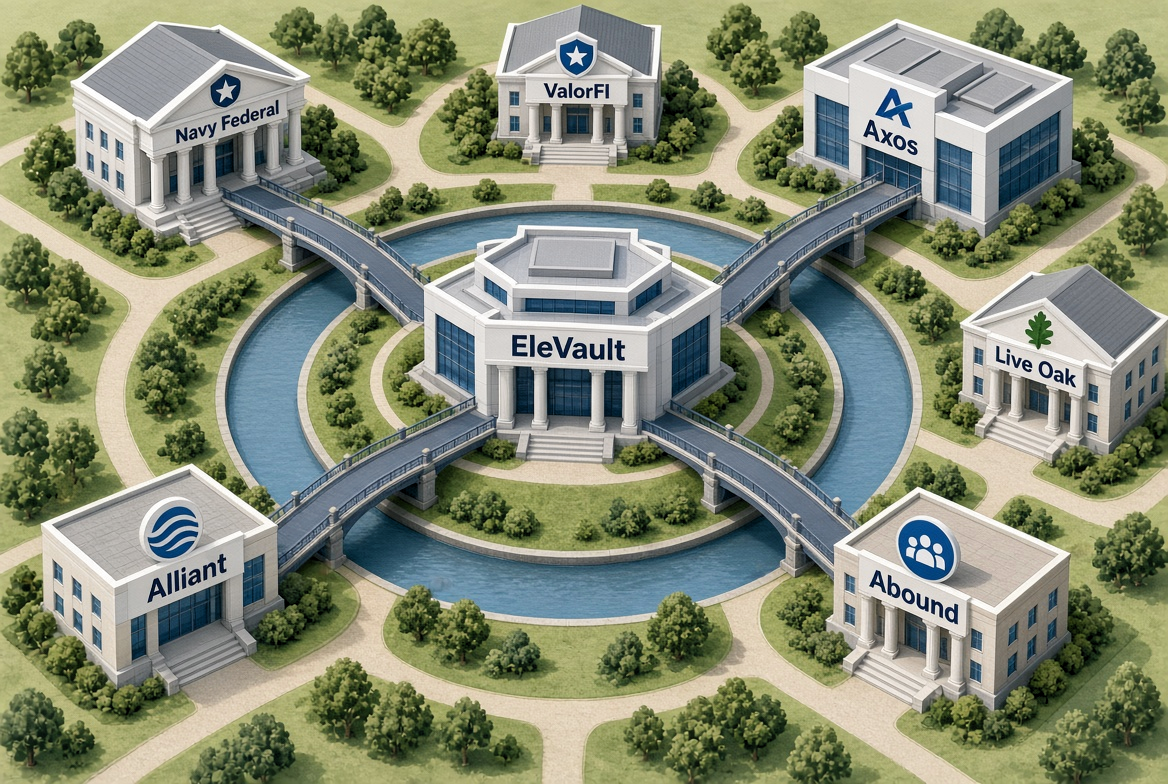
The illustration is the map. The surrounding institutions are not interchangeable, and every road shown does not imply that every institution connects to every other institution. Each leg still has to work on its own.
ValorFI → Abound → EleVault
Live Oak → Axos → EleVault
A missing direct connection is not necessarily a dead end. Sometimes you just need to get to the right Bridge.
Bridge Strength
Microdeposits are king.
A Bridge can work through Plaid or another instant-linking service if that service happens to connect the institutions you need. But manual account verification through microdeposits is usually the strongest Bridge-building capability because it is not limited to the aggregator’s list of supported institutions.
If a financial institution lets you enter a routing number and account number and verify ownership through microdeposits, you can often establish routes that do not appear in an instant-link search.
Microdeposits let you enter the address yourself.
Microdeposits do not guarantee that every account can connect or that every transfer will be permitted. Account type, ownership, ACH eligibility, limits, holds, and each institution’s rules still matter. But when I evaluate an institution for Bridge duty, manual microdeposit verification is one of the strongest capabilities it can offer.
The detailed mechanics of linking, push versus pull, ACH limits, holds, and transfer testing belong in the money-movement lesson. Here, the important point is simpler: the more dependable ways an institution can establish external connections, the more useful it can become as a Bridge.
The Cost of the Detour
A Bridge adds another trip.
A Bridge solves a routing problem by adding a detour. That detour costs time.
If Bank A cannot reach your Vault directly but Bridge B can reach both, the money may travel from A to B and then from B to the Vault. Those are two separate ACH trips. The first truck has to reach the Bridge before the second truck can carry the load onward.
Each leg can have its own daily or monthly limit, processing time, cutoff, weekend delay, hold period, and availability rule. Money showing as posted at the Bridge does not always mean it is ready to travel again.
That makes Bridges excellent for planned movement and potentially poor for money that has to arrive tomorrow. Before relying on a Bridge, learn how long the entire trip normally takes—not just one leg.
The best Bridge is the one that can carry the load, in the time you have, and remain dependable.
Know Your Bridges
Not every Bridge carries the same load.
Once you have more than one Bridge, test them and learn what each one is good at. One may be fast but have a lower transfer limit. Another may carry a larger amount but hold incoming money longer. Another may have excellent microdeposit connectivity but slower travel time.
Keep practical notes on the Bridges in your own ecosystem:
- Which institutions can it actually reach?
- Does it support the transfer direction you need?
- What are the practical dollar and transaction-count limits?
- How long does each leg normally take?
- When does incoming money become available to send onward?
- Does it support manual linking and microdeposit verification?
- Does it charge a fee or require activity you do not want?
- Has repeated pass-through activity caused holds, questions, or review?
A published limit tells you what the transfer system may allow. Your testing tells you what the Bridge actually does in the real world.
A connection is a possibility. A tested, dependable route is a Bridge.
Risk Tolerance
A Bridge has to tolerate traffic.
A financial institution can be technically capable of serving as a Bridge and still decide that it does not like the pattern of activity your route creates.
I learned that with Abound. Money came into the account and then moved onward to another institution. That activity drew attention and I had to explain what I was doing. I was not hiding the movement or sending money to someone else. I was moving my own money through an institution that connected two parts of my Banking Ecosystem.
“I use several financial institutions for different purposes. This account is valuable because its external-transfer and manual-verification capabilities let me connect to another account I own that I cannot reach directly. Your institution is an important part of my banking ecosystem.”
You can also ask the institution in advance whether that use is permitted under its account terms and whether there is anything it wants you to do differently. Do not assume a representative can override fraud or risk controls, and do not try to work around a restriction.
If an institution tells you that it does not want that activity, then it may have lost its Bridge role. It may still be useful as an Anchor, Specialist, Reserve, or for some other job. But a Bridge that will not reliably let you cross is not much of a Bridge.
More Than One Route
Multiple Bridges give you capacity and resilience.
Having more than one tested Bridge gives you choices. You do not have to make one institution carry every load or depend on one transfer service for every trip.
If a large amount has to move, several legitimate routes may be available. Choose among them based on actual transfer limits, speed, holds, availability, and reliability. There is nothing wrong with using more than one of your own tested routes when that makes the movement more practical.
The purpose is not to hide activity or avoid an institution’s controls. The purpose is to avoid creating a single point of failure and to use the capabilities of your Banking Ecosystem intelligently.
Build alternate routes before the route you depend on becomes unavailable.
Choose a Bridge for the work it does.
A Bridge does not have to be your everyday bank. It may sit almost empty. You may rarely use its debit card or other services. That does not make it useless.
If an institution creates a dependable route to somewhere the rest of your system cannot reach, it has earned a real job.
Do not open accounts merely to draw a prettier network. Start with the institutions you already control. Test the routes. Keep the connections that perform useful work. Replace the ones that stop earning their role.
Link only accounts you own or are authorized to use, follow each institution’s terms, and describe your transfers accurately. A different Bridge can provide a different legitimate route or limit; it does not erase fraud controls or give you permission to evade a restriction.
Date your route notes and retest after material changes. Transfer systems, limits, holds, aggregators, and institutional risk tolerances can change.
The valuable thing is not the extra account. It is the dependable route.
BankCraft Protocol
Building and Keeping a Bridge
Find the route. When a direct connection fails, look for an institution you already control that can connect both sides.
Prefer strong connectivity. Instant linking can work well, but manual microdeposit verification can make an institution especially valuable for Bridge duty.
Know what it can carry. Record practical limits, travel time, holds, availability, and whether the Bridge tolerates the traffic pattern you need.
Test before you depend on it. A two-leg route means two transfers and two opportunities for delay.
Keep another route. A Bridge can change its limits, lose a connection, or decide it no longer wants the activity. Build resilience before you need it.
Stay within the rules. A tested, permitted, dependable route is a Bridge. A route you have to hide is not.